
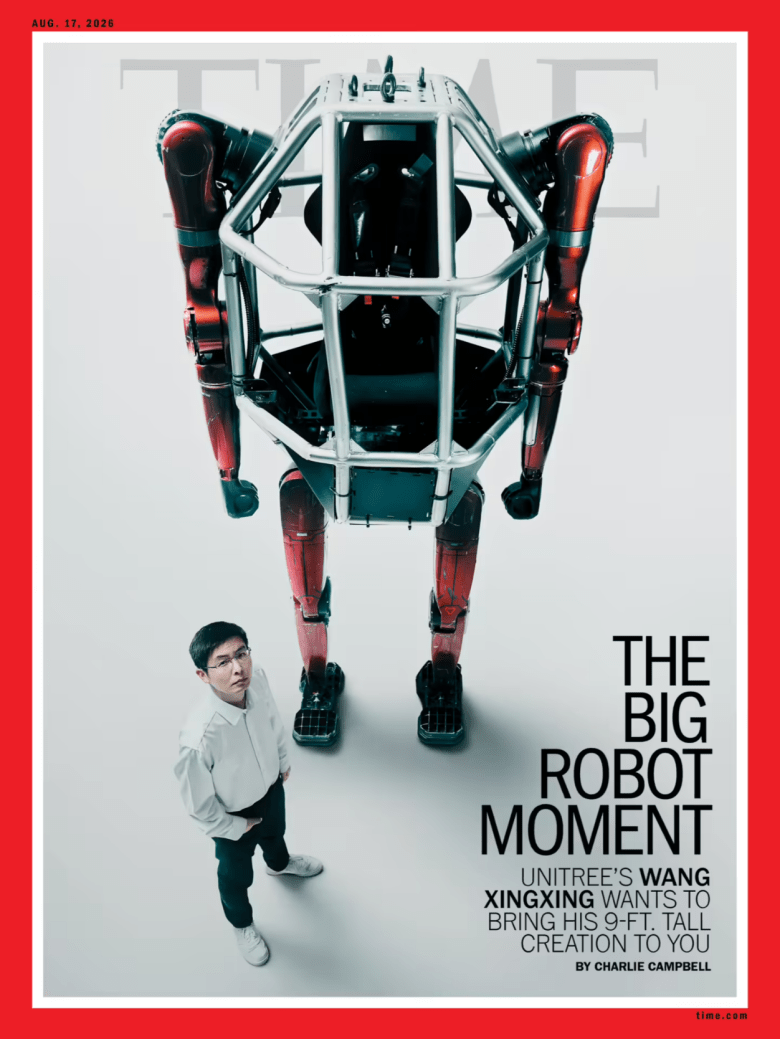
In 2026, Unitree Robotics once again put itself at the center of the robotics industry’s conversation. Last month, Unitree founder and CEO Wang Xingxing appeared alongside the company’s GD01 manned mech on the cover of TIME magazine.
In the image, the nearly 2.7-meter-tall GD01 takes up almost the entire frame, while Wang stands to its right, looking almost like a footnote beside the towering machine. The remaining space carries the headline: The Big Robot Moment.
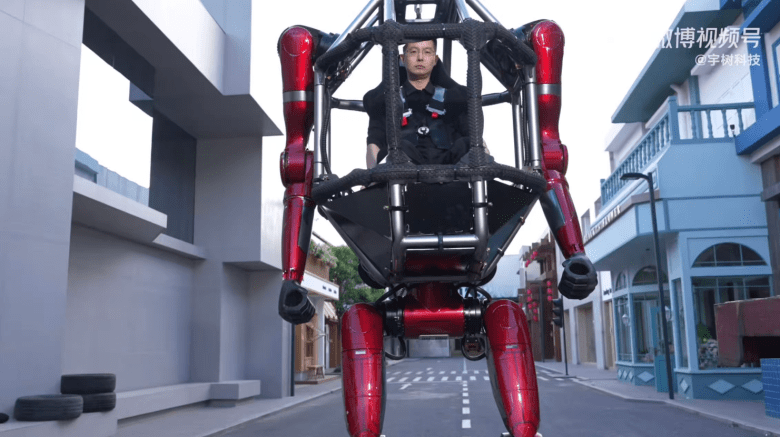
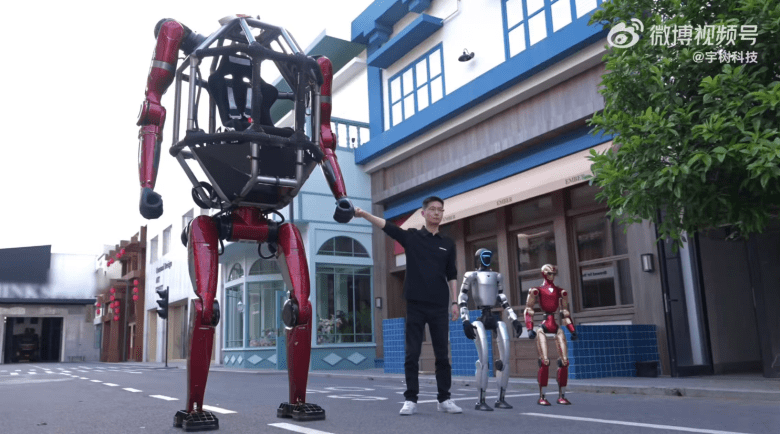
Reportedly, the GD01 is the world’s first mass-produced manned mech. Weighing around half a ton, it is operated from a cockpit inside the robot’s torso. The machine can move on two legs or switch to four-legged locomotion, while its two fists are powerful enough to break through walls.
Its feet are connected to a carbon-fiber protective shell through heavy-duty mechanical hinges. The imposing machine has red mechanical legs that allow it to move steadily.
Unlike Unitree’s earlier robots, which were primarily designed for research, education and industrial applications, the GD01 is an attempt to explore how robots could operate in more complex environments.
The product combines Unitree’s accumulated expertise in motion control, robotic structural design and intelligent interaction, pointing to a broader shift in robotics from single-purpose machines toward more versatile intelligent platforms.
When Unitree unveiled the GD01, the market’s first reaction was almost universally: science fiction has become reality. But from a broader perspective, what makes the GD01 worth watching is not simply whether it looks like a mech from a movie.
More importantly, it sends a signal about where the industry is heading: robotics is moving from a phase defined by competition over the robot itself to one defined by competition over what robots can actually do.
In terms of product positioning, the GD01 is neither a conventional industrial robot nor a consumer robot. Instead, it is a robotic platform designed to explore future intelligent mobility scenarios.
By combining bipedal movement, quadrupedal locomotion and manned control, the machine can adapt its form of movement to different environments, potentially giving it greater flexibility across complex terrain and diverse scenarios.

Unlike traditional automated equipment that relies on fixed tracks or highly structured environments, the GD01 attempts to overcome limitations in robotic mobility and expand the range of unstructured environments that robots can enter. Potential applications include operations in hazardous or specialized environments, emergency rescue, inspection and transportation, as well as future intelligent mobility scenarios.
With more advanced motion control and intelligent interaction capabilities, the GD01 is ultimately attempting to address one of the central challenges of bringing robots into the real world: how to adapt to complex environments and carry out increasingly sophisticated tasks.
Over the past several years, China’s robotics industry has gone through its first phase of rapid growth. Quadruped and humanoid robots have continued to set new benchmarks in mobility, which has evolved from running and backflips to dancing and increasingly complex movements.
Robots have steadily moved closer to matching human physical capabilities. Unitree emerged as one of the leading players during this period, building its expertise in motion control through products ranging from its consumer-oriented Go series robot dogs to its G1 and H-series humanoid robots.
But simply being able to move is becoming less sufficient as a competitive advantage.
As more companies enter the embodied intelligence race, the focus of competition is shifting. The key question is no longer simply whether a robot can move, but whether it can actually accomplish useful tasks.
Future robots will need to operate in real-world environments such as logistics, manufacturing, inspection and rescue, becoming intelligent machines capable of generating real economic value rather than products designed primarily to demonstrate technological capabilities.
The GD01 has emerged against this backdrop. It represents a new direction in robotic product development: combining more sophisticated mechanical structures, stronger mobility and more intelligent control systems to expand the range of environments in which robots can potentially operate.
The GD01 also reflects a shift in how robotics companies compete. In the past, companies primarily competed on metrics such as the number of joints, movement speed and hardware specifications. Going forward, the real differentiators are likely to be a robot’s ability to understand its environment, execute tasks and leverage the AI systems behind it.
The GD01 may never become the highest-volume robot on the market, but it could become an important case study for understanding the technological direction of China’s robotics industry. What it demonstrates is more than a single robotic product. It points to a broader industry trend: robots are moving out of the laboratory and into the real world.
The industry still faces significant challenges before robots can enter everyday life on a large scale. These include cost, safety standards, battery life and the maturity of commercial applications. How to bring down manufacturing costs, accumulate useful data through long-term operation and establish comprehensive safety standards remain critical questions for the industry.
In the coming years, industrial production, hazardous-environment operations and professional services are likely to remain among the most realistic areas for robotic deployment. One thing, however, is becoming increasingly clear: competition in robotics has entered a new phase.
Over the past decade, the industry focused on one fundamental question: how do we make robots move. Over the next decade, the question will be: how do we make robots create real value.






0 Commentaires